FILE NW/018 — HISTORICAL NOTE
ARCHIVE · NEXT WORLDFritz Houtermans: The Real Physicist & The Defector
Discover the real history of physicist Fritz Houtermans and his fictional role as the defector who unlocks the secrets of Element 115 in Resonance Portal Wars.
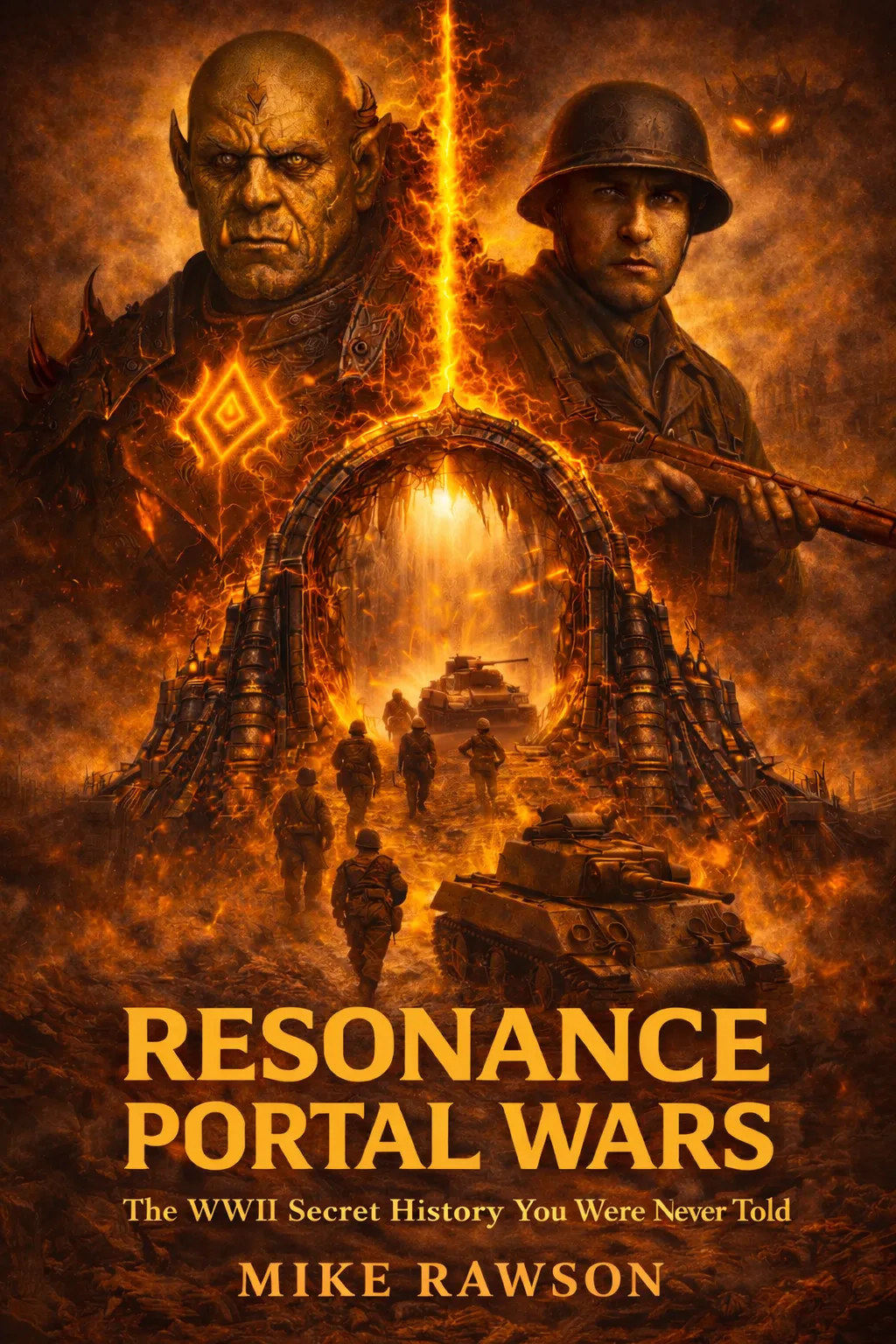
Note: This page covers the real history of Dr Fritz Houtermans alongside his fictionalised role in the novel up to the London portal experiments (Tier A spoilers).
What really happened: The physicist caught in the crossfire
Friedrich Georg "Fritz" Houtermans was a brilliant, unorthodox physicist whose real life reads like a geopolitical thriller. Born in 1903, Houtermans made his name in the late 1920s when he and Robert d'Escourt Atkinson calculated that stars generate their energy through nuclear fusion. It was a monumental breakthrough in astrophysics, proving that the stars were essentially colossal nuclear reactors.
However, Houtermans’s personal politics quickly placed him in severe danger. A member of the German Communist Party, he fled Germany when Adolf Hitler took power in 1933. Believing he would find refuge in the Soviet Union, he moved to Kharkov in 1935 to continue his research. Instead, he walked directly into Joseph Stalin’s Great Purge. The NKVD arrested him in 1937, accusing him of espionage and sabotage. He was brutally tortured and held in Soviet prisons for two years.
Following the signing of the Molotov-Ribbentrop Pact, the Soviets handed Houtermans over to the Gestapo in 1940. He found himself imprisoned in Berlin, trapped by the very regime he had originally fled. Thanks to the tireless intervention of prominent German physicists, particularly Max von Laue, Houtermans was eventually released from Gestapo custody. He was subsequently barred from traditional academia but found employment at a private research laboratory run by Manfred von Ardenne, where he conducted research on nuclear fission.
In 1941, Houtermans calculated that a nuclear reactor could produce a new element—what we now know as plutonium—which could be used as a weapon of mass destruction. Horrified by the prospect of a Nazi atomic bomb, Houtermans quietly worked against the regime from the inside. He managed to smuggle a message to the United States via a colleague, Fritz Reiche, warning the Allies that the German nuclear project was well underway.
Houtermans survived the war and later settled in Switzerland, where he made profound contributions to geochemistry and cosmochemistry. He famously calculated the age of the Earth using isotopic dating of meteorites, arriving at a figure remarkably close to the currently accepted age. His legacy is one of survival and brilliance, a man who navigated the darkest political currents of the twentieth century while quietly resisting the tyrants who sought to exploit him.
In the novel: The defector of Wałbrzych
In Resonance Portal Wars — Book 1, Mike Rawson shifts Houtermans’s wartime ordeal into the shadow war of Nazi occultism and interdimensional gates. Houtermans is portrayed as a scientist of fractured loyalties, deeply involved in the Reich's most terrifying black project. He understands the mechanics of Element 115 better than almost anyone, and his fear of what the SS is building under Hans Kammler finally drives him to defect.
The extraction falls to Commander Ian Fleming and the legendary Polish resistance fighter Witold Pilecki. Pilecki’s network locates the physicist in Wałbrzych, occupied Poland, attending a rare birthday dinner with only a single SS driver for protection.
The operation is swift and bloody. Pilecki silences the SS guard in the street, pulling a terrified Houtermans into a stolen getaway car driven by Fleming. The extraction quickly deteriorates into a frantic chase through the fog. A German patrol intercepts them, leading to a desperate shootout on a dirt road spanning a deep ravine. A young Polish operative named Janek is killed in the crossfire before Pilecki manages to shred the pursuing truck’s tyres, sending the SS vehicle off the bridge.
The fog and wet cobblestones of Wałbrzych serve as a grim backdrop for a mission where every second counts. The death of Janek underscores the brutal cost of intelligence warfare; Stefan, the surviving Polish operative, carries the boy's body into the trees for a nameless burial before the Lysander departs. As they reach the waiting aircraft in a moonlit field, Houtermans is visibly shaken, struggling to comprehend the risk the Allies took to secure him.
"You risked all this—for me?" "No," Fleming said. "For what you might unleash. And what we might still stop."
Houtermans warns them that they have no idea what the Nazis are attempting to build, expressing a profound terror that the Reich has opened a door to forces older than time.
The London laboratory
Houtermans is transported to a heavily warded, subterranean portal laboratory in London. Here, he comes face-to-face with the impossible: British engineers working alongside Elven mages to reconstruct a portal of their own. Fleming, a man accustomed to the concrete realities of naval intelligence, relies on the physicist to bridge the gap between alien physics and human engineering.
It is Houtermans who provides the missing piece of the puzzle. The Allied portal is highly volatile, threatening to rip the chamber apart with every activation. Houtermans explains that the Nazis stumbled upon their interdimensional rifts by accident. The secret lies in Element 115, a material recovered from a crashed craft during the 1939 Neuschwabenland Expedition.
The physicist describes the material to Fleming and the Elves with a mixture of reverence and dread:
"They claimed it came from a crashed craft in Antarctica. A single fragment, no larger than a dollar bill, wedge-shaped, impossibly dense. Copper-gold. Crystalline. It gleamed as if lit from within, and the light… shifted, as though it wanted to be seen."
Houtermans reveals that the Element is not merely a power source, but something that behaves with an unnerving sentience. It defies conventional physics, generating an anti-gravitic field and bending light. Worse, it exerts a terrible psychological toll on those who handle it. He recounts the fate of a Nazi colleague who touched the crystal just once, only to wake speaking unknown languages with eyes wide with "something not human" before falling permanently silent.
A desperate bargain
The revelation alarms the Elven delegation. Eldrin, the Elven healer, recognises that Element 115 sings in a key similar to the forbidden magic that caused the Sundering of Ilyndor. He fears that using it to stabilise the Allied portal might irreparably corrupt Earth's dormant leylines, twisting the local Resonance into a parasite that feeds on the environment.
Despite his fear of the Element, Houtermans confirms that it is the only viable stabiliser for the transit corridor. Without it, the portal will never safely manifest, leaving the Allies entirely blind to the Nazi war machine currently marching into Ilyndor. The stakes force a grim compromise between the two desperate factions.
Fleming, assessing the defecting scientist with cold pragmatism, strikes a hard bargain. He demands that once the portal is active, Element 115 must remain under strict Allied control, ensuring the Nazis can never weaponise it further.
Houtermans agrees, though the pause before his answer suggests the physicist is calculating the odds of survival against betrayal. He has seen firsthand what the SS is willing to do in the Owl Mountains. The defector knows that the Nazis are not simply trying to win a war of borders—they are tearing a hole through reality itself. Whether Houtermans’s cooperation is born of genuine repentance or raw survival instinct remains an open question as the Allies prepare to take the fight to the enemy.
Keep reading
- Element 115 and the 1939 Antarctic Crash
- Ian Fleming in Naval Intelligence & RPW
- Witold Pilecki: The Real Polish Hero
- The 1939 Neuschwabenland Expedition
Frequently asked
Was Fritz Houtermans a real person?
Yes, Friedrich Georg Houtermans was a brilliant real-world physicist who made major contributions to stellar nucleosynthesis and nuclear fission. He survived imprisonment by both the Soviet NKVD and the Nazi Gestapo during the Second World War.
How does Houtermans fit into the Resonance Portal Wars universe?
In the novel, he is a scientist with fractured loyalties working on the Nazi portal project. Horrified by the Reich's interdimensional discoveries, he defects to the Allies and explains the terrifying nature of Element 115.
Who rescues Houtermans in the novel?
He is extracted from occupied Wałbrzych by British intelligence officer Ian Fleming and Polish resistance fighter Witold Pilecki. The daring rescue results in a deadly chase with the SS.
What does Houtermans reveal about Element 115?
He reveals that the copper-gold crystal was recovered from an ancient craft in Antarctica and is highly volatile. He warns the Allies that the element exhibits an unnatural sentience and exacts a terrible psychological toll on those who handle it.