FILE NW/012 — HISTORICAL NOTE
ARCHIVE · NEXT WORLDThe 1939 Neuschwabenland Expedition
Explore the real history of the 1938–39 German Antarctic Expedition, the Nazi UFO myths it spawned, and how it sparks the alternate history in the novel.
Spoiler tier: This archive page covers Tier A early-book events, contrasting real-world history with the alternate timeline of Resonance Portal Wars.
What really happened: The 1938 expedition
In the late 1930s, the German economy was facing a severe resource crisis, specifically regarding its fat and oil supplies. Relying heavily on imported Norwegian whale oil to produce margarine and soap, the Third Reich sought to secure its own resources and reduce reliance on foreign imports as war loomed. This urgent economic necessity birthed the German Antarctic Expedition of 1938–1939.
Commanded by Captain Alfred Ritscher of the Kriegsmarine, the expedition sailed aboard the MS Schwabenland, a vessel uniquely equipped with a steam catapult for launching aircraft. They arrived off the coast of Queen Maud Land in January 1939. For the next month, the crew used two Dornier Wal flying boats—named Passat and Boreas—to conduct extensive aerial surveys, photographing hundreds of thousands of square miles of the frozen, unforgiving continent.
To formally claim the territory for Germany, the flight crews dropped thousands of aluminium darts stamped with swastikas across the ice. They named the vast region Neuschwabenland (New Swabia) after the expedition’s ship. The scientific teams recorded valuable oceanographic and meteorological data, discovered previously unknown mountain ranges, and returned to Germany by April 1939. Ritscher had planned a follow-up expedition for 1940, but the outbreak of the Second World War permanently halted any further overt German exploration of the Antarctic.
The birth of an Antarctic myth
History records the Neuschwabenland expedition as a brief, resource-driven venture that achieved its limited scientific and territorial goals. However, in the decades following the collapse of the Third Reich, the mission became the focal point for some of the most enduring legends of the twentieth century.
Rumours began to circulate that the expedition was merely a cover, and that the Germans had established a massive, subterranean military base—often referred to as Base 211—hidden beneath the glacial ice. Proponents of these myths claimed that elite Nazi scientists and SS officers fled to this fortress in the final days of the war, taking highly advanced, secret weaponry with them.
The most famous of these legends involved Die Glocke (The Bell) and the Reichsflugscheiben (Nazi flying saucers). According to the folklore, the Ahnenerbe—the SS occult and historical division—had discovered ancient, extraterrestrial technology in Antarctica and spent the war reverse-engineering it into anti-gravity craft. When the United States launched Operation Highjump in 1946, a massive naval exercise led by Admiral Richard E. Byrd, conspiracy theorists claimed its true objective was to eradicate this hidden Nazi holdout.
While historians and scientists have repeatedly dismissed these stories as physical impossibilities, the myth of the Nazi Antarctic fortress remains a staple of secret history and science fiction.
In the novel: The frozen revelation
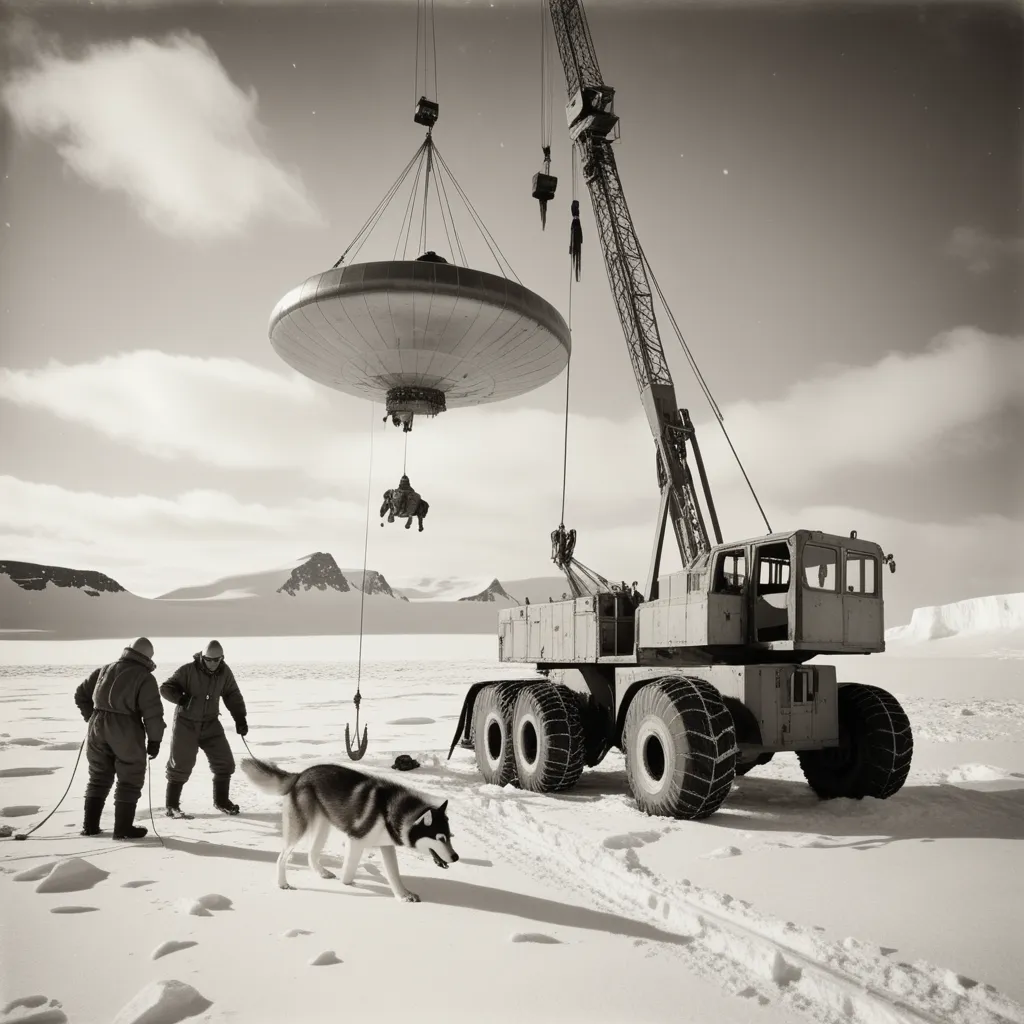
In the opening chapters of Resonance Portal Wars, the Neuschwabenland myths are turned into a terrifying reality. In the book’s alternate 1939, Captain Alfred Ritscher is still at the helm of a crawler convoy navigating the howling white abyss, but the true architect of the mission is SS Obergruppenführer Hans Kammler.
Acting on the occult obsessions of Heinrich Himmler, who had briefed the team months earlier in the candlelit chambers of Schloss Wewelsburg, the Ahnenerbe is not hunting for whale oil. They are searching for a power older than humanity. Dr Ernst Herrmann, the expedition’s lead geologist, guides the convoy to a jagged, unnatural spire of ice jutting from the plateau. The area is plagued by intense magnetic anomalies that immediately induce nausea and burning pressure behind the men’s eyes.
"Extraordinary," Herrmann murmured. He brushed frost from the spire, revealing faint engravings—lines and shapes too deliberate to be natural. "The magnetic field is strongest here. Whatever lies beneath… it’s highly magnetic."
Under Kammler’s ruthless orders, engineers deploy cutting torches and flamethrowers to melt through the millions of years of hardened ice. What they uncover is a vast, saucer-like structure resting at a steep angle. Its smooth, obsidian-like plating shows no signs of corrosion, and the hull is covered in runes that seem to shift subtly when observed too closely. One particular symbol draws Dr Herrmann's gaze: a triangle enclosing a single, unblinking eye.
(A Tier B mystery running throughout the lore is who or what actually left Element 115 buried deep in the ice, and why the symbol of the triangle-and-eye keeps appearing to those who meddle with it.)
Element 115 and the cost of discovery
The ultimate prize rests at the centre of the buried saucer. When Kammler steps into the stale, ancient air of the craft, he discovers an impossibly dense, wedge-shaped crystal of copper-gold: Element 115. Suspended within a lattice of impossibly thin metallic filaments, the crystal emits a deep, rhythmic hum.
When Kammler presses his gloved palm against the pulsing metal, he receives a static jolt that crawls up his spine. For a fleeting heartbeat, space itself seems to resist; he sees a silhouette of himself staring inward from beyond the ice, cold and eternal. He recognises the hum not as a mere mechanical vibration, but as an impatient question from a sentient intelligence that has been waiting.
The recovery of the craft takes three brutal days, and the physical and psychological toll on the German excavation team is catastrophic. The men refer to the sickness as radiation, but the effects of the corrupted Resonance are profoundly invasive. The Element whispers to those who handle it, breaking their minds down.
Three engineers collapse with crushing migraines, their hands trembling uncontrollably. One technician claims his vision has split entirely, leaving him watching himself from two places at once. Another man rips off his gloves and weeps, hallucinating that he is standing in a hallway with his mother, while another wakes in the night screaming in an ancient tongue no one recognises.
But the crystal does not break Hans Kammler. Where the other men suffer profound fatigue and paranoia, the SS engineer grows sharper, stronger, and more focused. Kammler lingers beside the humming craft for hours, absorbing an aura of power that terrifies his subordinates more than the cold.
It is this single, copper-gold fragment that he will carefully conceal and take back to the Owl Mountains of Poland, setting the stage for the creation of Die Glocke and the tearing of the gate to Ilyndor.
Keep reading
- Hans Kammler: The SS Engineer of the Bell Gate
- Element 115 and the 1939 Antarctic Crash
- Die Glocke: The Nazi Bell and the Gate to Ilyndor
- Resonance: The Magic of Ilyndor
Frequently asked
Did the Nazis really send an expedition to Antarctica?
Yes. The 1938–1939 German Antarctic Expedition sailed to Queen Maud Land to secure whaling grounds for oil and fat supplies. They mapped the region using flying boats but never built military bases in the ice.
What is the myth of Base 211?
Post-war legends claimed the retreating SS built a secret, high-tech fortress under the Antarctic ice called Base 211. These myths often feature advanced anti-gravity flying saucers, though they have been entirely debunked by historians.
How does the Neuschwabenland expedition feature in Resonance Portal Wars?
The novel opens with a fictionalised version of the expedition. Captain Ritscher and SS officer Hans Kammler uncover an ancient, buried saucer in the ice, retrieving a powerful crystal known as Element 115 that alters the course of the war.