FILE NW/002 — ARCHIVE RECORD
ARCHIVE · NEXT WORLDElement 115 and the 1939 Antarctic Crash
The real 1939 Neuschwabenland expedition, the Die Glocke legend, Bob Lazar's Element 115 — and how Resonance Portal Wars turns them into the most dangerous discovery of the Second World War.
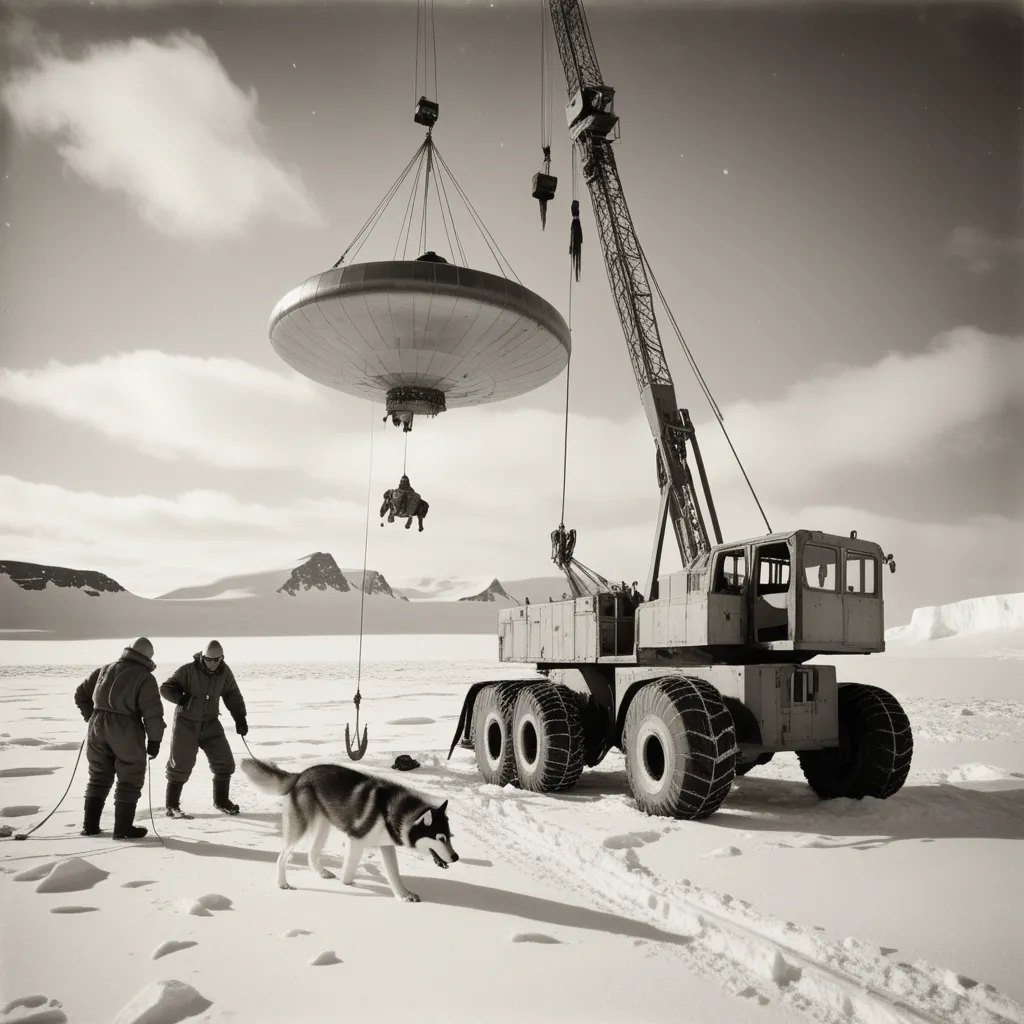
Fact and fiction, clearly labelled. Sections marked What really happened are history. Sections marked In the novel describe Resonance Portal Wars — Book 1 and contain no major spoilers.
In February 1939, seven months before Germany invaded Poland, a Nazi expedition planted swastika flags on the Antarctic ice. That much is history. Resonance Portal Wars asks a simple question about it. What if they found something?
What really happened: the Schwabenland expedition
The German Antarctic Expedition of 1938–39 sailed from Hamburg in December 1938 aboard the catapult ship Schwabenland, commanded by Captain Alfred Ritscher. Its stated aims were economic: Germany wanted a stake in Antarctic whaling, and a territorial claim would help. Two Dornier flying boats were launched by catapult over Queen Maud Land. They photographed hundreds of thousands of square kilometres and dropped aluminium darts stamped with swastikas to mark the claim. The Germans named the region Neuschwabenland.
The expedition was back in Hamburg by April 1939. The war ended any plans to return. But the expedition left behind something more durable than a territorial claim: a myth. After 1945, stories spread of a secret German base under the ice, of U-boats ferrying scientists south, and of Admiral Byrd's 1946–47 Operation Highjump meeting "unusual opposition". None of it is supported by evidence. All of it is irresistible to a novelist.
In the novel: what was under the ice
In Resonance Portal Wars, the expedition carries an extra party: tracked snow-crawlers, a geologist named Dr Ernst Herrmann, and an SS engineer, Hans Kammler, sent by Himmler himself. They are not hunting whales. They are following a magnetic anomaly that Himmler's occult research bureau, the Ahnenerbe, believes marks a power "older than the Aryans themselves".
They find a spire of ice that sends instrument needles spinning and leaves grown men reeling with nausea. Under it, buried at a steep angle, is a saucer-shaped craft with seamless, uncorroded plating. On the hull, among symbols that seem to shift if you stare at them, one mark draws the eye more than the rest: a triangle enclosing an eye.
Herrmann sees it and says what every reader is thinking: "This… this is not of this Earth."
At the heart of the craft, suspended in a lattice of hair-fine filaments, is a crystal that hums. The men who work near it get migraines, double vision and hallucinations. One wakes up screaming in a language nobody knows. Kammler is the exception. Near the crystal he becomes sharper and stronger, and he can't stay away from it. That detail matters more than anything else in the opening chapters.
Element 115: fuel, weapon, or something else
German scientists call the crystal Element 115. In the novel it is copper-gold, wedge-shaped and impossibly dense. It bends light, and it whispers to the people who handle it.
That name is deliberate. In 1989 Bob Lazar claimed he had worked on alien craft near Area 51 that were powered by a stable isotope of element 115. Real element 115, moscovium, was synthesised in 2003. Its atoms last a fraction of a second. Lazar's stable version has never been demonstrated. Resonance Portal Wars keeps the name and gives it a far more unsettling job.
Element 115 amplifies. In the novel's world everything runs on Resonance, a living magic carried through lines of power in the earth. Element 115 makes Resonance stronger. It also makes it wrong. Characters who know the magic best can feel the corruption creeping into everything the crystal touches. Where that corruption leads is one of the book's central questions, and we won't answer it here.
Die Glocke and Project Riese
What really happened: Under the Owl Mountains in today's Poland, the Nazis dug Project Riese, a network of tunnels built by forced labour in which thousands died. Its purpose has never been fully established. In the 2000s, writers popularised a legend about a device called Die Glocke ("The Bell"), supposedly linked to SS General Hans Kammler, the real officer in charge of the Reich's secret construction projects, who vanished in 1945. No document confirming the Bell has ever surfaced.
In the novel: The Bell is real, and it works. It is ceramic-cased, fuelled by a swirling compound called red mercury and run by Dr Walter Gerlach's team. Once Element 115 is installed, it tears open a portal. On the night it first opens, something steps through from the other side. Later, the engineers learn they can hold the door open for about eight minutes before the uranium feeding it runs out. They send a canary through, and it comes back unharmed. Then they start sending men.
The portal is also why, in the novel, Hitler turns on the Soviet Union. Holding a door open costs uranium, and the uranium is in the East. It is one of several places where the book rewires a real turning point of the war.
Why this matters for the story
Everything in Resonance Portal Wars traces back to that crystal in the ice. The portal opens onto Ilyndor, a dying world of orcs, elves and Grimfangs. The orc warlord Durgar rides into Normandy in a black SS trench coat. The elven commander Lithariel ends up standing in Churchill's war room. Kammler's climb through the Reich, and the British scramble to understand what Bletchley Park keeps decrypting, all start with the same piece of glowing metal.
And there is still the symbol on the hull. The triangle and the eye turn up again and again in the novel: on the craft, on German paperwork, stitched into an officer's uniform. Nobody in the first half of the book can say who put it there. Readers who finish Book 1 will have their own theories.
Keep reading
- Durgar, Chieftain of the Drublog Clan — the orc who rode into Normandy in an SS coat.
- Commander Lithariel — the elf who watched her world break.
- Want the whole file? The Classified 1939 Dossier pulls every thread of the discovery into one document. It's free when you join the list for Book 2.
Frequently asked
Did the Nazis really go to Antarctica in 1939?
Yes. The German Antarctic Expedition of 1938–39, led by Captain Alfred Ritscher aboard the Schwabenland, photographed a large part of Queen Maud Land from the air and claimed it as Neuschwabenland. There is no evidence it found anything unusual. The buried craft is the novel's invention.
Is Element 115 real?
Element 115, moscovium, was first synthesised in 2003 and officially named in 2016. It is extremely unstable and lasts a fraction of a second. Bob Lazar's 1989 claim that a stable form powered alien craft has never been substantiated. Resonance Portal Wars borrows that idea and makes the element far stranger.
What is Die Glocke in Resonance Portal Wars?
In the novel, Die Glocke ('The Bell') is the ceramic-cased machine beneath Project Riese that uses Element 115 to tear open a portal to another world. The real Die Glocke is a post-war legend with no documentary evidence.
Do I need to know the history to enjoy the book?
No. The novel explains everything it uses. The history is there for readers who like to know where the fiction starts.