FILE NW/024 — HISTORICAL NOTE
ARCHIVE · NEXT WORLDElement 115 (Moscovium): Real Science & UFO Legends
Explore the real history of moscovium, Bob Lazar's Area 51 UFO claims, and how Element 115 powers the Nazi portal in Resonance Portal Wars.
Fact vs Fiction: This page explores the real-world science and UFO legends of Element 115 (moscovium), alongside its role as a cosmic power source in Mike Rawson's novel Resonance Portal Wars. Contains Tier A spoilers.
What really happened: The S-4 Whistleblower
Long before it earned a place on the periodic table, Element 115 entered public consciousness through the explosive claims of Bob Lazar. In 1989, Lazar gave a television interview in Las Vegas, claiming he had been hired to reverse-engineer extraterrestrial technology at an ultra-secret military facility called S-4, located just south of Area 51 in Nevada.
According to Lazar, the US government possessed several captured alien saucers. He alleged that these craft were powered by a stable isotope of a superheavy element unknown to terrestrial science: Element 115. Lazar described the fuel as a heavy orange metal, often machined into small wedges. When bombarded with protons in a small onboard reactor, the element would transmute into Element 116, immediately decaying and releasing antimatter. This reaction purportedly powered a gravity-wave generator, allowing the saucer to fold space-time and cross vast interstellar distances instantly.
Lazar's claims sent shockwaves through the UFO community. Despite intense scrutiny from physicists—who pointed out that superheavy elements are typically highly unstable—the legend of Element 115 took root in pop culture. It became the ultimate science-fiction fuel, synonymous with government cover-ups, black projects, and visitors from the stars.
What really happened: Forging Moscovium
Mainstream science eventually caught up with the periodic table, though the reality of Element 115 was vastly different from Lazar's stable alien fuel. In 2003, a joint team of Russian and American scientists achieved a historic breakthrough at the Joint Institute for Nuclear Research (JINR) in Dubna, Russia.
Using a particle accelerator, the team bombarded a target of americium-243 (a radioactive actinide) with a beam of calcium-48 ions. The violent collision briefly fused the atomic nuclei, creating a handful of atoms of a brand-new superheavy element containing exactly 115 protons.
Initially assigned the placeholder name ununpentium, the discovery was officially recognised by the International Union of Pure and Applied Chemistry (IUPAC) in 2015. The following year, it was formally named moscovium (symbol Mc) in honour of the Moscow Oblast where it was synthesised.
Real moscovium is incredibly unstable. Rather than powering an anti-gravity drive, its most stable known isotope (moscovium-290) has a half-life of less than a single second. It undergoes rapid alpha decay, breaking down almost instantly into lighter elements like nihonium. While theoretical physicists speculate about an "island of stability"—a region on the periodic table where superheavy isotopes might boast longer lifespans—a stable version of Element 115 remains entirely within the realm of science fiction.
In the novel: The Cosmic Catalyst
In the alternate history of Resonance Portal Wars, Element 115 is neither a laboratory experiment nor a Nevada desert secret. It is a genuine, terrifyingly powerful artifact that changes the course of the Second World War.
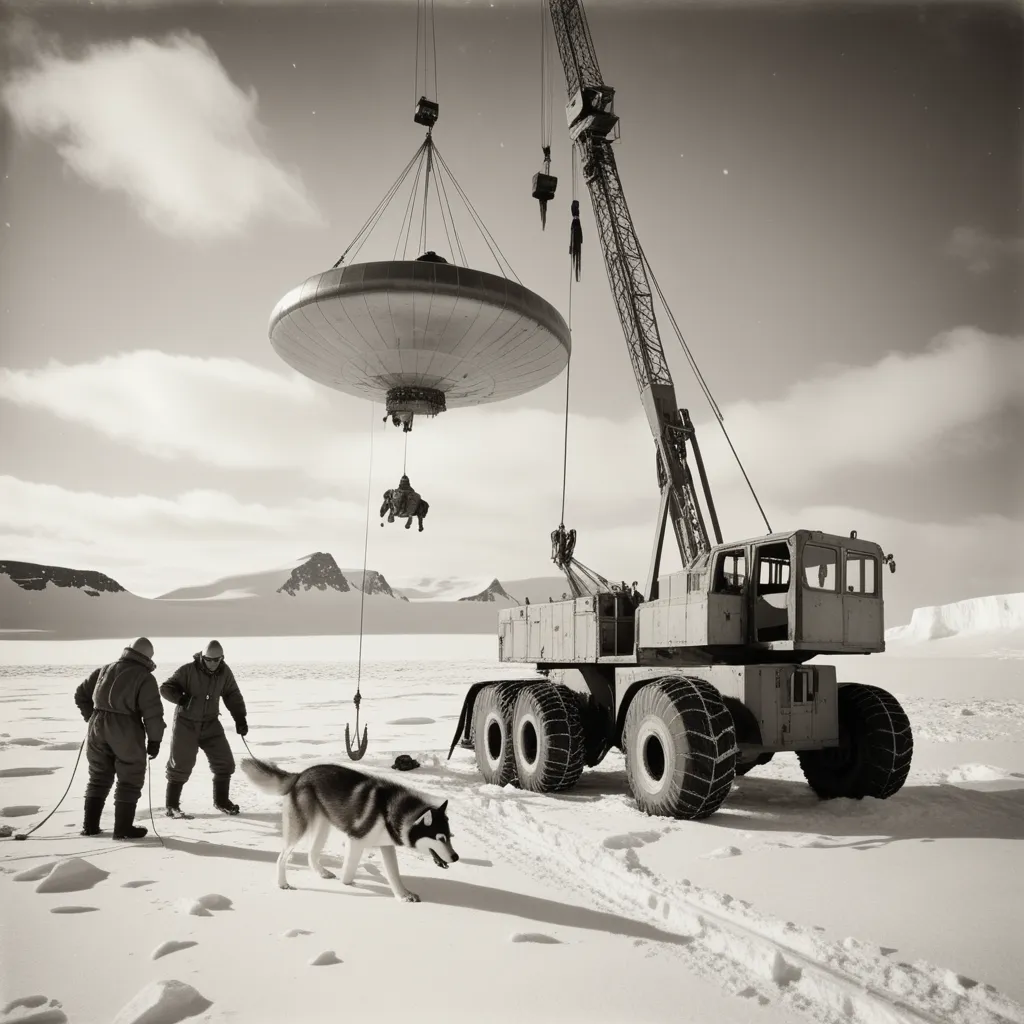
During the 1939 Neuschwabenland expedition, German explorers unearth an ancient, unblemished saucer buried deep beneath the Antarctic ice. When they crack the hull open, they discover a crystalline structure suspended in a metallic lattice.
The core of the craft—the glowing crystal unearthed from the Antarctic ice—became known as Element 115. Even under controlled conditions, its properties defied physics. It emitted a faint gravitational field that warped the space around it, bending light into impossible angles, generating energy that dwarfed human understanding.
Described as copper-gold, wedge-shaped, and impossibly dense, this material is no ordinary fuel source. It exudes an unsettling presence, a sentient hum that interacts directly with human consciousness. The technicians and scientists who recover it suffer severe psychic trauma. Men report crushing migraines, split vision where they perceive themselves standing in two places at once, and night terrors that cause them to speak in unknown, ancient tongues.
However, SS engineer Hans Kammler is immune to these debilitating effects. Instead, prolonged exposure makes him sharper, colder, and more focused. Sensing a profound, primeval connection to the crystal, Kammler secretly removes a small fragment of Element 115, wearing it as a hidden pendant. Through it, he experiences visions of a dark void and a geometric lattice, sensing two cosmic forces locked in a proxy war over Earth.
In the novel: Powering the Bell Gate
Recognising the material's staggering potential, the Nazis transport the cargo to Project Riese, an underground complex in the Owl Mountains of occupied Poland. There, the SS builds Die Glocke—a towering, ceramic-encased bell fueled by red mercury. Element 115 serves as the catalyst.
When activated, the machine amplifies the dormant leylines running beneath the earth, manipulating Resonance (magic) on an industrial scale. The combination rips open a portal to Ilyndor, a dying world populated by Elves and orcs.
Yet the power of Element 115 comes with a terrifying cost. It amplifies Resonance, but it fundamentally corrupts it. The magic is twisted into a destructive force known as Decay. When Orcish shamans attempt to weave their spatial and temporal spells near the German portal, they find the magic hostile and tainted. The element acts as a parasite on the natural leylines, threatening to unravel the cosmic balance of both worlds entirely.
In the novel: The Allied Response
The existence of this cosmic fuel does not remain hidden for long. Intercepted German Enigma transmissions raise alarms at Bletchley Park, prompting Winston Churchill to initiate a shadow war to secure the material.
The Allies learn of the Nazis' dimensional ambitions when Polish resistance hero Witold Pilecki and British intelligence officer Ian Fleming extract Dr Fritz Houtermans, a defecting physicist. Houtermans reveals the horrifying truth about the Antarctic crystal and the Bell Gate.
Determined to counter the Reich, the Allies secure their own shard of Element 115 from a secret OSS vault. Fleming undertakes a perilous transatlantic flight from Wright-Patterson Airbase in Ohio to deliver the lead-lined container to London. The Allies hope to use the shard to stabilise their own portal, allowing them to dispatch commandos and Elven allies to sabotage Kammler's operations from the other side. Yet, the Elven healers remain deeply fearful of the material, warning that the copper-gold crystal is a profane force that belongs to neither Earth nor Ilyndor.
Unanswered questions
The discovery of Element 115 in the Antarctic ice raises profound mysteries that haunt the characters throughout the novel. Who exactly placed the craft beneath the glacier? A recurring motif—a rune depicting a triangle enclosing a single eye—is found etched onto the saucer's hull and repeatedly haunts Kammler's dreams.
Did rival cosmic intelligences plant the element as a gift to propel humanity forward, or is it a deadly trap designed to corrupt the leylines and tear reality apart?
Keep reading
- The 1939 Neuschwabenland Expedition
- Element 115 and the Antarctic Crash
- Hans Kammler: The SS Engineer
- Ian Fleming in Naval Intelligence & RPW
Frequently asked
Is Element 115 real?
Yes, Element 115 is a real synthetic element named moscovium. It was first synthesised by a joint US-Russian team in 2003 and officially added to the periodic table in 2016.
Did Bob Lazar discover Element 115?
No. Bob Lazar popularised the idea of Element 115 in 1989, claiming it was a stable isotope used as alien spacecraft fuel at a secret facility near Area 51. Real Element 115 was synthesised more than a decade later and decays in milliseconds.
How does Element 115 work in Resonance Portal Wars?
In the novel, it is an impossibly dense, copper-gold crystal found inside a buried UFO in Antarctica. The Nazis use it to power Die Glocke and open an interdimensional portal, though it dangerously corrupts natural magic.