FILE NW/019 — HISTORICAL NOTE
ARCHIVE · NEXT WORLDProject Riese: The WWII Tunnels and the Bell Gate
Explore the tragic real-world history of Project Riese in the Owl Mountains and its role as Hans Kammler's subterranean portal laboratory in the novel.
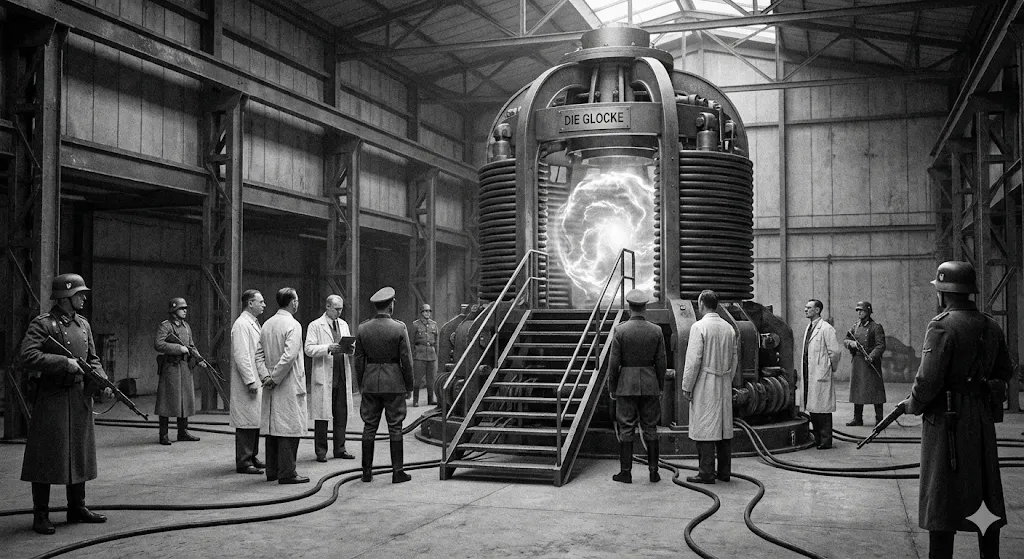
This archive page covers both the sobering reality of the Second World War forced labour programme in the Owl Mountains and its fictionalised role in Mike Rawson’s novel Resonance Portal Wars — Book 1. It is spoiler-free for new readers.
What really happened: The tragedy of Project Riese
During the latter stages of the Second World War, as the tide of the conflict began to turn against Germany, the Nazi regime initiated one of its most secretive and massive construction efforts: Projekt Riese (Project Giant). Located in the Owl Mountains of Lower Silesia—a region that was then part of Germany and is now in southwestern Poland—the undertaking aimed to hollow out entire mountains. It involved creating a vast network of subterranean tunnels, reinforced concrete chambers, and railway systems, including expansive works beneath the grand Książ Castle.
Historians still debate the ultimate purpose of Project Riese. Some assert it was meant to serve as a secure underground headquarters for Adolf Hitler and the military elite, shielding them from the increasingly devastating Allied bombing campaigns. Others argue it was designed to house relocated arms factories, secure chemical weapons storage, or research facilities for experimental technologies like rocketry or aviation. Because the fleeing German forces systematically destroyed many of the blueprints and records in 1945 before the Red Army arrived, the full scope and true intent of the project remain lost to history. Vast sections of the tunnels were collapsed or flooded, sealing their secrets in the dark.
What is unequivocally documented, however, is the catastrophic human cost. To carve this subterranean network out of solid rock, the SS relied on forced labour, drawing primarily from the Gross-Rosen concentration camp and its numerous subcamps. Thousands of prisoners of war and inmates—many of them Jewish—were forced to work in appalling, lethal conditions deep underground. Malnutrition, waterborne diseases, exhaustion, and brutal, arbitrary treatment by SS guards meant the mortality rate was horrific. Men worked twelve-hour shifts in freezing, damp caves, breathing in stone dust and explosive fumes. The unfinished tunnels of the Owl Mountains remain a sombre gravesite, a permanent historical marker of the atrocities committed in the pursuit of the Reich's wartime infrastructure.
In the novel: The Wenceslaus Mine
In Resonance Portal Wars, the historical mystery of the Owl Mountains is fused with wartime occult legends and the chilling logic of alternate history. The subterranean complex is re-imagined as the domain of Hans Kammler, the cold, ambitious SS Obergruppenführer tasked with weaponising a crashed alien craft. Operating deep within the Wenceslaus Mine—a real-world coal mine tied to the Project Riese infrastructure—Kammler’s facility is not merely a bunker or a munitions factory. It is a highly classified laboratory designed to pierce the fabric of reality itself.
The novel does not shy away from the brutality of the complex's construction. Kammler's command of the project is built directly on the blood of the innocent. The text explicitly acknowledges the dark foundations of his subterranean empire, framing the sprawling tunnels as a monument to suffering.
Hans Kammler, SS Obergruppenführer, stood at the edge of the vast subterranean chamber, his cold eyes surveying the empire of steel and stone he had built with ten thousand corpses beneath the Owl Mountains.
The narrative portrays Kammler as a man devoid of compassion, remembering his father’s cruel doctrine that mercy is merely weakness wearing the mask of duty. For the SS engineer, the deaths of the labourers are simply the necessary mathematics of progress, a transaction made to secure limitless power:
Power demanded sacrifice. And for Kammler, there was no price too high. The bones of countless laborers lay entombed within these walls, their bodies the foundation of the Reich’s future.
The Bell Gate and Element 115
At the heart of Kammler’s Polish complex sits Die Glocke, a towering, ceramic-encased machine. Fueled by swirling red mercury and the unearthly, copper-gold crystal known as Element 115, the Bell forms the core of the project. Within the reinforced chambers of Project Riese, Kammler and his lead scientist, Dr Walter Gerlach, push the boundaries of physics until they break.
The environment inside the subterranean laboratory is unnerving. The air reeks of ozone and machine oil, illuminated by the machine's violet-blue and crimson plasma glow. But the true horror of the complex is psychological. The Element 115 housed within the mountain warps space and bends light into impossible angles. Workers and SS guards stationed in the tunnels suffer from vivid nightmares, paranoia, and crushing migraines. Some report their reflections no longer matching their movements, or experiencing déjà vu in reverse. The mountain complex becomes a place where the laws of nature begin to unravel, driven by a quiet, pulsing hum that feels less like a sound and more like a question being asked by a dormant intelligence.
It is here that the Reich first breaks through the dimensional veil. In a violently erratic experiment, the machine generates an iridescent, pulsating vortex. Through this portal, the SS make their first, bloody contact with the inhabitants of Ilyndor. When three monstrous, green-skinned orc warriors step through the rift, they immediately butcher the laboratory guards in a flurry of brute strength and jagged axes. Kammler executes the final surviving orc himself. Instead of horror, he feels only exhilaration. The facility in the Owl Mountains is locked down, the dead incinerated, and the project escalated.
The eight-minute window and global consequences
As the experiments in Project Riese progress, the Nazi scientists discover strict limitations to their newfound gateway. Sustaining the portal requires immense amounts of uranium to feed the plasma reaction. Due to the Reich's limited reserves, the portal can only be held open for a maximum of eight minutes—a strict operational window that dictates the first human incursion into Ilyndor.
After sending a canary through the vortex to test the alien atmosphere, Kammler dispatches a hand-picked trio of SS commandos, led by Kurt Dietrich, into the unknown. The commandos step out of the Wenceslaus Mine and into the dying, green-lit world of the orc shaman Balfur Skullrend. The strict countdown forces a panicked retreat when the scouts are ambushed by Grimfang riders, resulting in the deaths of two men and Dietrich's terrified escape back into the Polish cavern.
This subterranean base sets the stage for the conflict's global escalation. The immense uranium requirements of the portal directly influence the war's timeline. In the novel, Adolf Hitler receives confirmation of the portal’s success at the Reich Chancellery. Recognising that conventional warfare is obsolete, he declares that Germany will no longer merely rule the Earth, but will forge a "thousand-planet Reich". To secure the vast uranium deposits of the Soviet Union required to fuel the Owl Mountains portal, Hitler orders the immediate invasion of the USSR. Thus, the secretive work within Project Riese becomes the fictional catalyst for Operation Barbarossa, transforming a global conflict into a war for existence itself.
Keep reading
- Die Glocke: The Nazi Bell and the Gate to Ilyndor
- Hans Kammler: The SS Engineer of the Bell Gate
- Element 115 and the 1939 Antarctic Crash
- Balfur Skullrend: Shaman-Chief of Grom'Karn
Frequently asked
What was the real Project Riese in WWII?
Project Riese was a massive, unfinished construction effort undertaken by Nazi Germany in the Owl Mountains between 1943 and 1945. Relying heavily on brutal forced labour from concentration camps, it involved carving miles of tunnels and bunkers into the rock for highly secretive military purposes.
How is the Wenceslaus Mine used in Resonance Portal Wars?
In the novel, the Wenceslaus Mine is reimagined as Hans Kammler’s highly classified subterranean laboratory. It houses Die Glocke and the alien crystal Element 115, serving as the birthplace of the interdimensional portal to Ilyndor.
Why did Hitler order Operation Barbarossa in the novel?
The novel reimagines the invasion of the Soviet Union as a direct result of the portal experiments. The gateway requires vast amounts of uranium to remain stable, prompting Hitler to invade the USSR to secure its deposits for his multidimensional conquest.
What happens to the workers near Element 115?
Exposure to Element 115 within the mountain complex causes severe psychological and physical symptoms. Guards and scientists report crushing migraines, split vision, and unnerving phenomena like delayed reflections and strange voices.