FILE NW/001 — PERSONNEL FILE
ARCHIVE · NEXT WORLDDurgar, Chieftain of the Drublog Clan
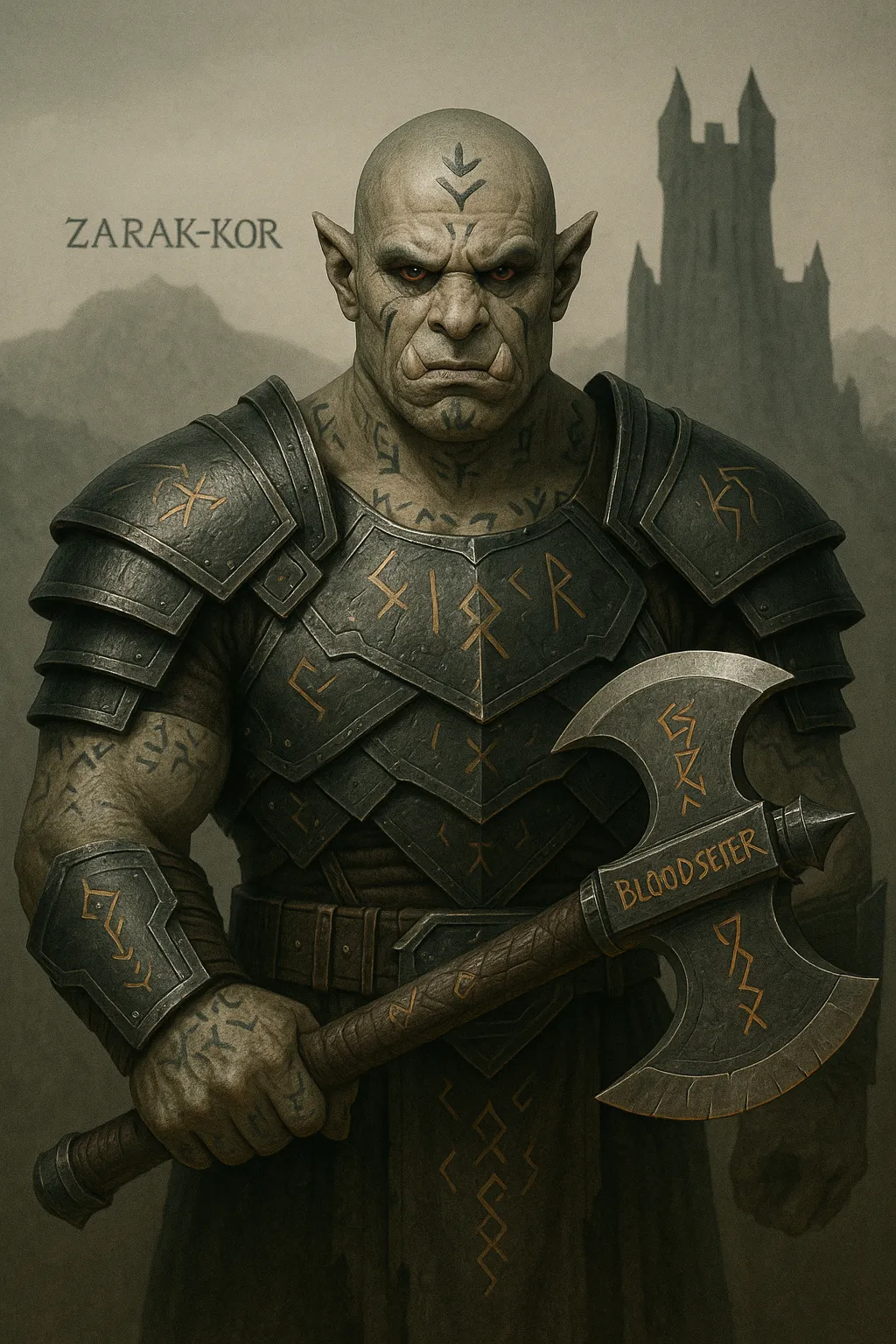
Who is Durgar in Resonance Portal Wars? The orc warlord of the Deathbound Brotherhood, his axe Bloodsever, the Bone March, and why he rides beside the SS without serving them.
Spoiler level: low. This page covers who Durgar is when Resonance Portal Wars — Book 1 opens. It does not reveal where his story goes.
The first time we meet Durgar, he is chasing a British commando through a Normandy forest on the back of a wolf the size of a horse. He wears a black SS trench coat. The red swastika armband is stretched across an arm too thick for it. Nobody watching mistakes him for a Nazi, and the SS men who rode out with him that night are afraid of him too.
Who is Durgar?
Durgar is the chieftain of the Drublog Clan and leader of the Deathbound Brotherhood, which the orcs of Ilyndor call the Korr'Shalakh. It is a centuries-old order of elite warriors, and the book is blunt about the price of entry: two out of three initiates die in the ritual to join. Those who survive are bound by a creed of blood and silence.
He comes from Ilyndor, the world on the far side of the Nazi portal. Ilyndor is dying. A cataclysm called the Sundering broke the magic that held it together, poisoned its rivers, and drowned a third of its land. Durgar's people have survived generations of that slow collapse, and it shows in him. He doesn't hesitate and he doesn't waste anything, and he has no patience for anyone who has never had to fight for survival.
At home he serves under Balfur Skullrend, the shaman-chief of Grom'Karn, as her second-in-command. He is her most trusted warrior. On Earth, in Normandy, he rides with Otto Skorzeny's SS. The novel spends a good deal of time on how both of those things can be true at once.
Bloodsever
Durgar's axe has a name: Bloodsever. Its runes pulse when it is used and flare when it kills, drinking the energy of the fallen. When Durgar takes the head of an opponent he respects, it is meant as a trophy, a sacrifice, a pledge.
In combat he is frightening. A British private drives a knife into his shoulder. Durgar doesn't flinch. He pulls the blade out, looks at it as if it were a dull toy, and throws it back. A jagged flame tattoo on his forearm glows red when he draws on Physical Resonance, the strand of Ilyndor's magic that hardens bodies and amplifies strength.
The Bone March
Every member of the Korr'Shalakh has walked the Bone March. It is a field of bleached skulls and shattered armour under a volcanic sky, left from an ancient battle against something that should never have crossed into Ilyndor. Initiates must cross it in total silence. One sound, and the warriors watching are sworn to kill them on the spot.
The Brotherhood's chant gives the flavour:
Bound by blood. Bound by silence. Death before dishonor. Ash to ash.
Durgar walked it when he was barely more than a boy. He came out the other side with a spiral scar beneath his collarbone. His brother didn't come out at all.
Why Durgar despises the Nazis
Durgar is not a convert to the Reich and doesn't pretend to be. When Skorzeny flatters him ("If we had a thousand of your kind, the war would already be over"), Durgar's private reply is one of the book's best lines:
If there were a thousand orcs, it would be your head for Bloodsever tonight.
He sees the Germans as people who know wires and machines and nothing about blood-oaths. He sits at their tables because his clan needs what they have and because he respects Balfur's judgement. He is a warrior from a dying world, weighing what his people's survival will cost him.
He also notices something the humans miss. Standing in the Normandy woods, he can feel leylines under the soil, dormant and sleeping but there, like the rivers of power under Ilyndor. The longer he stays on Earth, the more certain he becomes that the two worlds are connected. He keeps that to himself, and it becomes one of the threads the book pulls on.
Durgar and Lithariel
Durgar's family and the elves have a long history in blood. During the war that ended in the Sundering, Thanar, Durgar's father, led the orc war bands that broke the elves' last defences. The elven warrior who fell fighting him was the husband of Commander Lithariel.
When Durgar and Lithariel meet on the battlefield in Book 1, they are carrying more than their own grudges, and the book hints there is a moment in their past that neither of them talks about.
If you like Durgar, you'll like…
Readers who come to Resonance Portal Wars for the orcs tend to love the Grimfangs, war-wolves ridden by orc and SS alike. They also like Balfur Skullrend, whose ambition and appetite for dangerous power make her one of the book's most unpredictable characters. And there is the discovery in the Antarctic ice that put the whole war in motion.
Keep reading
- Commander Lithariel — the elf on the other side of Durgar's oldest feud.
- Element 115 and the 1939 Antarctic Crash — where the portal war began.
- The Classified 1939 Dossier includes a British intelligence profile of Durgar ("Under no circumstances engage at close quarters"). It's free when you join the list for Book 2.
Frequently asked
Is Durgar a villain?
He fights on the German side when the book opens, and he is brutal. But he despises the Nazis, is loyal to his clan, and has a code. Readers tend to argue about him.
What is Bloodsever?
Durgar's runed battle-axe. Its runes flare when it kills, drawing on Physical Resonance, and Durgar takes the heads of worthy opponents as a pledge.
What is the Korr'Shalakh?
The Deathbound Brotherhood, a centuries-old order of orc elites led by Durgar. Two out of three initiates die in the ritual to join, and every member must have walked the silent Bone March.
Where does Durgar first appear?
In the opening chapters, in Normandy in June 1941, during a British commando raid to capture Otto Skorzeny.