FILE NW/023 — ARCHIVE RECORD
ARCHIVE · NEXT WORLDChurchill and the Elves: The Cabinet War Rooms
Explore the history of Winston Churchill's Cabinet War Rooms and the thrilling moment in the novel when Elven warriors breach the underground bunker.
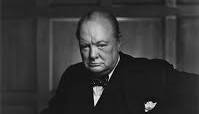
Fact vs. Fiction: This page contrasts the real history of Churchill’s Cabinet War Rooms with the events of Resonance Portal Wars — Book 1. It is safe to read if you are midway through the novel.
What really happened: The Underground Bastion
By 1940, the heart of the British war effort had been forced underground. Anticipating the devastating aerial bombardment that would become known as the Blitz, the British government constructed a secure command centre beneath the Treasury building in Whitehall, London.
Known as the Cabinet War Rooms, this subterranean bunker became the nerve centre where Prime Minister Winston Churchill and his military leaders directed the course of the Second World War. The atmosphere was notoriously stifling. A maze of reinforced concrete, the rooms were thick with dampness, the smell of wool uniforms, and the ever-present haze of Churchill's cigar smoke.
Here, the Chiefs of Staff—including men like General Sir Alan Brooke, Admiral Sir Andrew Cunningham, and Air Chief Marshal Sir Charles Portal—debated global strategy. They poured over sprawling maps, evaluating intelligence from Bletchley Park and plotting the survival of Britain. It was a place of grim reality and cold calculations, sealed away from the sky and entirely grounded in the brutal mechanics of industrial warfare.
In the novel: The Breach of Whitehall
In Mike Rawson’s alternate history, the tension within the Cabinet War Rooms is shattered by an event entirely outside the bounds of military doctrine. As the British High Command receives decrypted intelligence suggesting the SS are tampering with other dimensions via the Bell Gate, the impossible suddenly manifests in their secure bunker.
Deep in the Elven stronghold of Cormanthor, the Elves have activated the Aetherial Conduit. Because no Elf has ever set foot on Earth, they rely on a captured German commando, Tomas Leber, to act as an anchor. Leber focuses his mind on the only symbol of Allied power he knows: Winston Churchill's legendary war room.
The resulting portal tears directly into the subterranean chamber. The air pressure drops, the lights flicker, and a swirling vortex of energy warps the stone and timber of Whitehall. Maps and classified papers lift into the air as the rift stabilises, depositing four figures before the astonished British command: three tall, otherworldly Elves robed in silver and azure, alongside a dishevelled German soldier.
The Arrow and the Amulet
The sudden materialisation of alien beings inside the most secure room in the British Empire pushes the bunker's guards to the brink of panic.
The gunshot cracked through the air, the bullet screaming toward the otherworldly figures. A woman stepped forward in a blur—tall, radiant, bow already drawn. Her arrow loosed before the echo of the gunshot had faded. The glowing tip struck the bullet mid-flight, shattering it into a spray of harmless fragments that pattered against the floor.
With that single, impossible feat of archery, Commander Lithariel of the Elven Vanguard silences the room. Churchill, tracking the chaos with his cigar smouldering between his fingers, utters a response that perfectly encapsulates the collision of high fantasy and British wartime stoicism: "Bloody hell."
The Elven leader, Aelar Silverbreeze, steps forward to declare their peaceful intentions. To bridge the gap between their worlds, he presents Churchill with a silver amulet. The Prime Minister hesitates, briefly pondering the absurdity of taking a glowing magical artefact in the middle of a strategic briefing, before reminding himself that he is Winston Churchill.
As his fingers close around the silver, a clarifying warmth spreads through his mind, instantly translating Aelar's Elvish into perfect English. To prove the gravity of their mission, Aelar produces a shard of Element 115, the alien substance the Nazis are using to power their portals. The room's temperature plummets as the crystal pulses with a dark, hungry energy, offering undeniable proof that the Reich is tampering with cosmic forces.
The Twin-Strike Debate
The arrival of the Elves turns a conventional strategic briefing into an unprecedented debate over the fate of two worlds. The Elven delegation insists that the Allies must intervene in Ilyndor; if SS General Hans Kammler secures the alien leylines, he will use Element 115 to rewrite reality and launch attacks directly into the heart of London or New York.
The Allied commanders are fiercely divided. General Alan Brooke slams his fist on the table, declaring the proposal madness when Britain is already stretched to the breaking point. General Dwight D. Eisenhower questions the sanity of sending mortal soldiers to fight against forces that can manipulate time and space.
Frustrated by their hesitation, Lithariel abandons diplomacy for a demonstration of raw power. She weaves her fingers through the air, dimming the bunker's lights and causing the ink on the war maps to glow with ethereal script. She reminds the hardened generals that the portals are not merely doors, but fractures in the fabric of reality itself. If they ignore the threat in Ilyndor, the resulting Resonance Decay will inevitably consume Earth as well.
A compromise is forged in the smoke-filled bunker: the Twin-Strike Proposal. Allied forces, including Naval Intelligence officer Ian Fleming, will mount a tactical expedition into Ilyndor alongside the Elves to sabotage the German portal infrastructure. Simultaneously, Eisenhower and Brooke will marshal Earth's defences to repel any Nazi incursions.
The Sepia Photograph
Churchill is acutely aware of the incredible risk he has taken by allying with the Elves. The British public, and indeed most of his own military, would deem him insane if they knew the truth of what transpired beneath the Treasury building. Yet he firmly believes that conventional warfare alone cannot defeat an enemy who has harnessed the supernatural.
In a quiet moment after the Elven delegation departs the war room, Churchill opens a drawer beneath his heavy oak desk. Inside lies a photograph—sepia-toned, its edges already fading. It depicts the Prime Minister standing side-by-side with Commander Lithariel.
The image is a private relic, a grounding reminder of the unbelievable reality he has embraced. Staring at the photograph, Churchill reflects on the heavy burden of command in a war that has transcended the boundaries of logic and science. As he reaches for a fresh cigar, he mutters to the empty bunker, "A bit of madness might be all that's left to save us."
Keep reading
Explore more about the collision of World War II history and the magic of Ilyndor:
- Commander Lithariel — Discover the history of the Elven Vanguard's fiercest warrior and her legendary spear.
- Die Glocke and the Bell Gate — Learn how Nazi engineering and Element 115 tore a hole between dimensions.
- Ian Fleming in Naval Intelligence — Read about the man tasked with coordinating the Allied response to the supernatural threat.
- The Council of the Three Boughs — Delve into the fractured politics of the Elven leaders who sent Aelar and Lithariel to Earth.
Frequently asked
Where were Churchill's real Cabinet War Rooms?
The real Cabinet War Rooms were located underground beneath the Treasury building in the Whitehall area of Westminster, London. They were constructed to protect the British government core from aerial bombing during the Blitz.
How do the Elves reach London in the novel?
The Elves use an ancient artifact known as the Aetherial Conduit, anchored by the memories of a captured German commando named Tomas Leber. The portal opens directly into Churchill's secure underground bunker.
What happens when a guard fires at the Elves?
A panicked guard fires his weapon at the sudden intruders. Commander Lithariel draws her bow and fires an arrow infused with Resonance that shatters the bullet mid-flight, instantly neutralising the threat without bloodshed.
How does Churchill communicate with the Elves?
Aelar Silverbreeze offers Churchill a silver translation amulet covered in shifting runes. Upon taking it, the Prime Minister is immediately able to understand the Elves in perfect English.